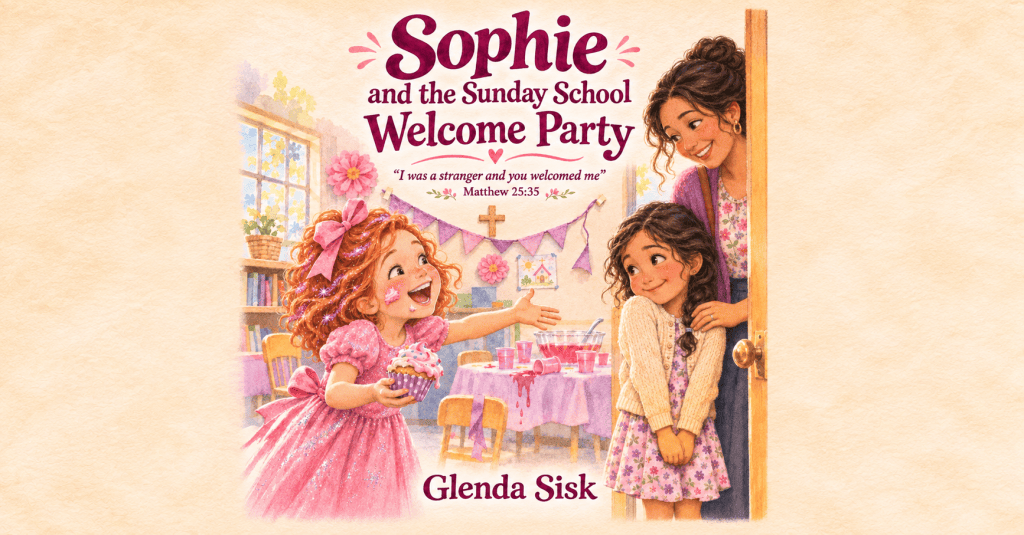
• Meet Sophie: A Little Redhead with a Great Big Heart

    It’s been a little quiet here lately, but there’s been plenty going on behind the scenes. Between polishing a manuscript and looking over illustrations, I’ve had my author hands full!

    Today, I’d like to introduce you to my little redheaded, mischievous, big-hearted girl, Sophie.

    Sophie rushes headlong into just about everything. If somebody needs help, she’s already on her way—sometimes before she’s stopped long enough to find out what they actually need. Give that girl a job, and she’ll give it everything she’s got. There may be a little mess along the way. Possibly a big one.

    But her heart is always in the right place.

    Sophie’s gift is her willingness to help. She wants to pitch in, make someone feel welcome, and do whatever needs doing. She doesn’t always get it right, but there’s something beautiful about a child who keeps showing up with her whole heart.

    This little girl’s name changed three times before I finally settled on Sophie. Through every name and every draft, though, that heart was always there. When I found her name, it just fit. She was Sophie.

    Right now, Miss Sophie is getting polished up with a revision before she heads back to an editor who has expressed interest in her story. There’s no promise of what comes next, but I’m grateful for the opportunity to work on her story and see where it leads.

    So that’s where I’ve been—spending time with a little girl who tends to rush in before she thinks.

    I have a feeling she and I might have a few things in common. ❤️✍🏻😉

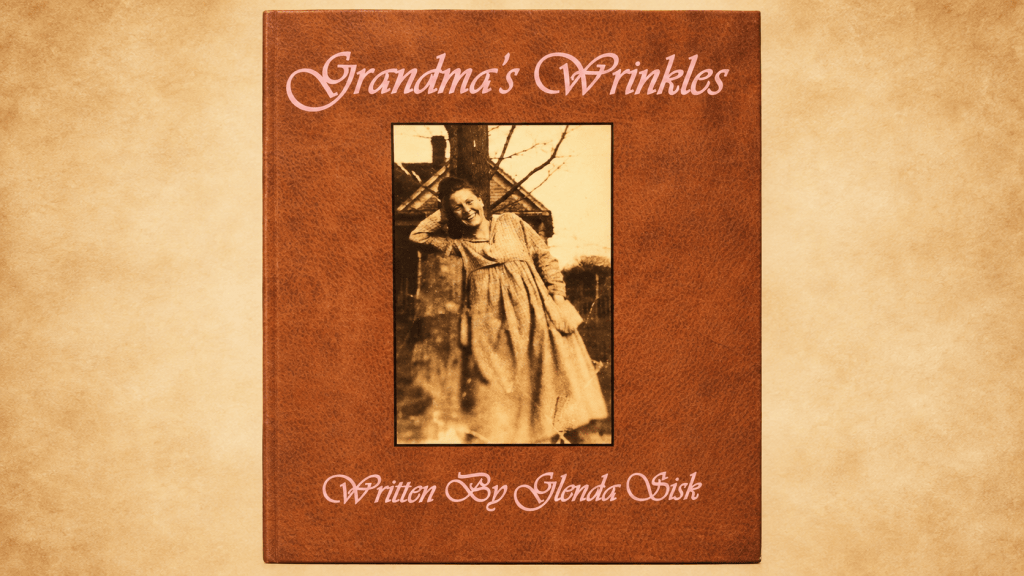
  • Grandma’s Wrinkles

    My grandmother traveled from Arkansas to Kentucky in a covered wagon, raised some mischievous boys, and carried nearly a century of memories in her heart.

    Some of those memories will make you smile. Others might bring a tear. And a few might remind you that Grandma knew a whole lot more about what her children were up to than they realized. 😉

    Those memories inspired Grandma’s Wrinkles, told through my daughter’s eyes and illustrated with our old family photographs.

    I also wrote it because I wanted children to see the value in an older person—their grandparents, great-grandparents, or someone whose stories they haven’t stopped to hear.

    I wanted them to understand that those years were filled with living. With laughter and mischief, dreams and hard work, love and heartache. Their grandparents were children once, too. They have stories worth hearing and experiences worth learning from.

    Before it became a published book, I read the manuscript at my grandmother’s funeral, with my family’s blessing. In the middle of saying goodbye, her stories gave us a chance to remember the life we had shared with her.

    Later, John Bell and VaBella Publishing helped me bring those memories into print.

    Now I get to share a little of my grandmother with you. And perhaps, after reading her story, a child will sit a little closer to their own grandmother and say, “Tell me about when you were little.” ❤️

    Buy Grandma’s Wrinkles on Amazon⁠

  • Once Mama’s little storyteller got a book published

    Then she packed up her books and went to work. Apparently, raising four children and working in a school hadn’t kept her busy enough. 🤣

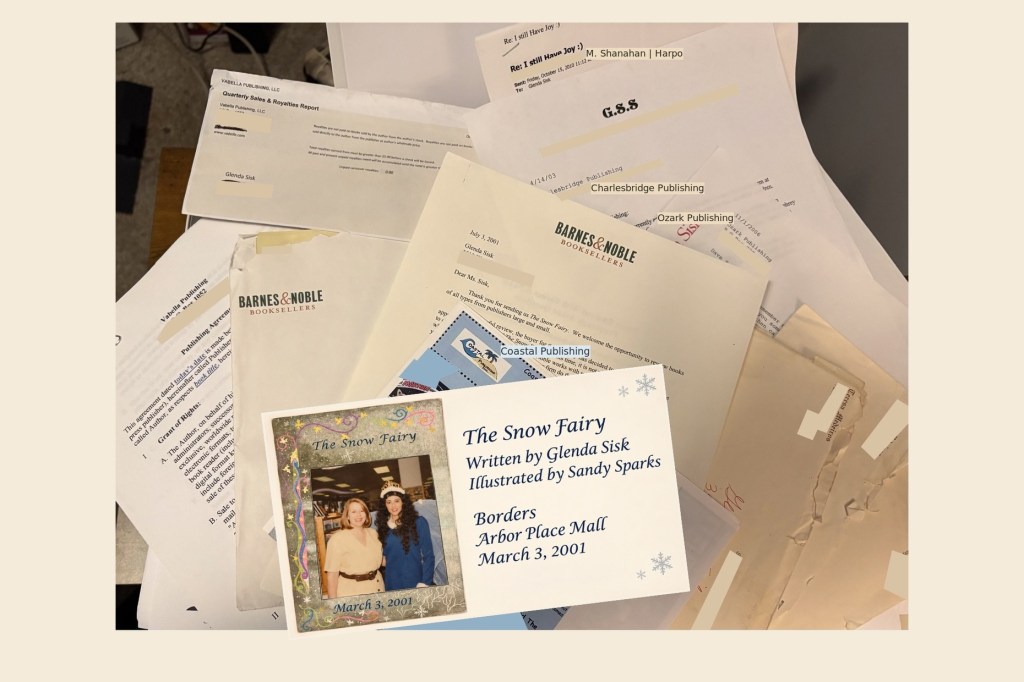
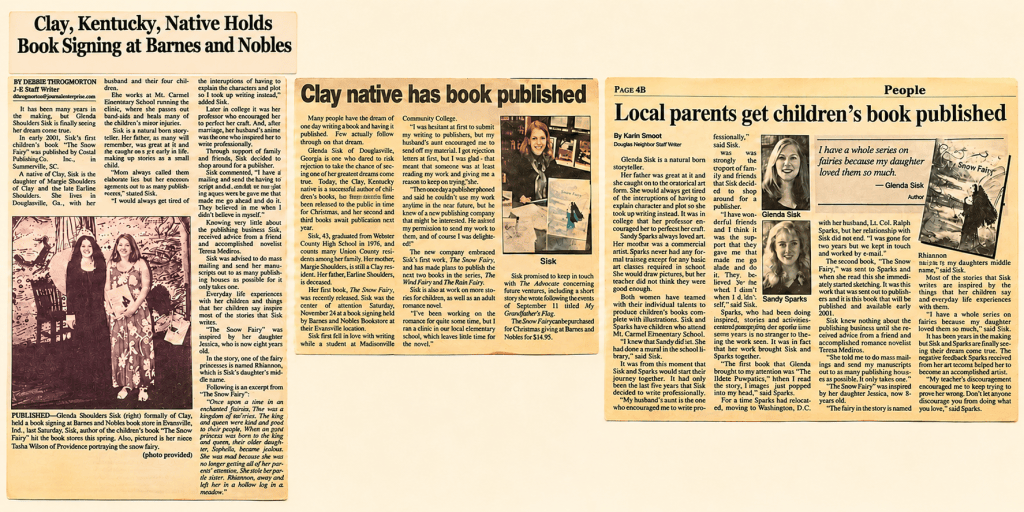
    I shared some newspaper clippings from those early writing years. Today, I’m sharing what happened when I took my stories out to meet their readers.

    But first, there was someone who helped me get started: Dave Sargent of Ozark Publishing.

    Dave told me what a great writer he thought I was. When you’re sending manuscripts into the world and wondering whether anyone will see something in them, encouragement like that stays with you. He also helped me get my first book published. I remain grateful that he saw promise in my work and helped open that door.

    Once The Snow Fairy became a book, I wanted to give it every opportunity I could.

    That meant contacting bookstores, making arrangements, packing books, and showing up. I had two appearances at Barnes & Noble and two at Borders, along with multiple school visits in Georgia, Kentucky, and Missouri.

    Have books, will travel? Honey, I meant it.

    The school visits brought together two things I loved: children and storytelling. After years of working in education, I knew how much imagination could fit inside a classroom. Getting to walk into one as an author and share a book I had written was something special.

    There were stories to read, questions to answer, and children to encourage. I wanted them to know that their ideas mattered, too. Somewhere in those classrooms might be another little storyteller whose mama thought she was telling whoppers.

    And yes, there were little bags of fairy dust. If I was bringing The Snow Fairy, I wanted to bring a little magic along with her.

    Then came John Bell and VaBella Publishing, who published Grandma’s Wrinkles, a book that tells a piece of my family’s story through photographs.

    I also appeared on a Christian internet show with Pastor Daldred Mason, giving me another opportunity to share my writing and the journey behind it.

    Then there was the possibility that had me especially excited: during the final season of The Oprah Winfrey Show, I was seriously considered for an appearance.

    My contact was Meagan Shanahan, and she read my blog. The appearance never happened, but the conversations did—and I still have the emails.

    You can imagine how closely I was watching my inbox.

    Looking through these memories now, I remember the preparation behind them. The letters and emails. The phone calls. The arrangements made around work and family. The books and materials that had to be ready before I ever walked through a bookstore or classroom door.

    I was learning as I went, asking questions, following up, and putting myself out there because I believed in my stories.

    And I loved meeting the people on the other side of the page.

    Those photographs hold more than a younger version of me sitting at a signing table or standing in front of a classroom. They hold the work I put into being there—and the joy of finally sharing something that had begun in my imagination.

    Now I’m back with more stories, more life experience, and that same willingness to roll up my sleeves.

    I may need a little more room in the car these days. I’ve got quite a few manuscripts.

    But I still have books to share and places to go. ❤️

    Now it’s time to get back to work. ❤️📚

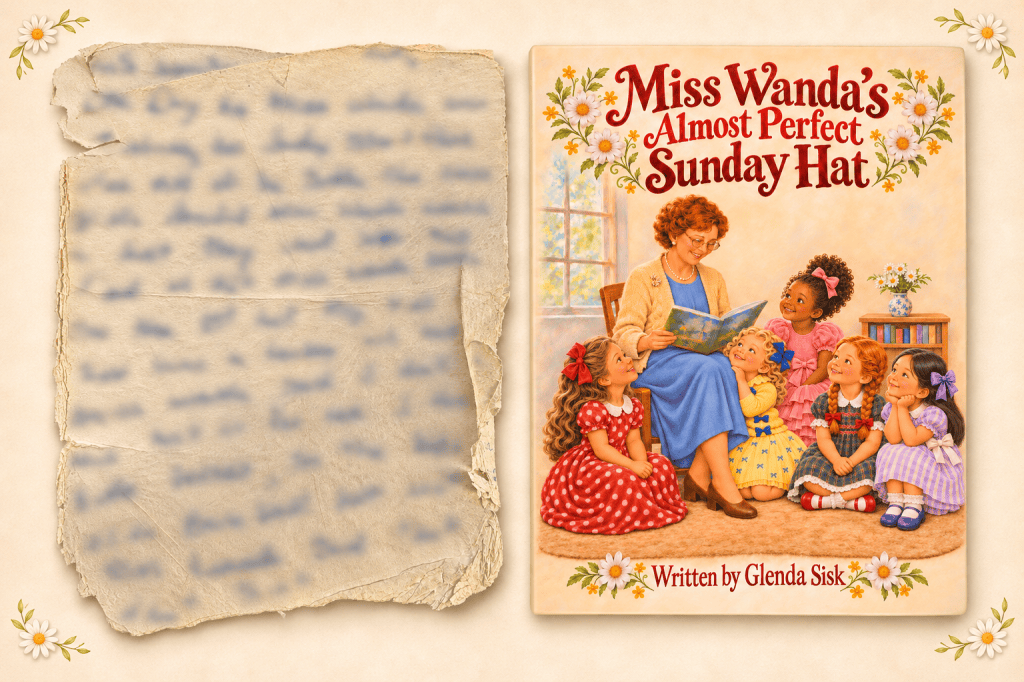
  • Some stories begin in beautiful notebooks. Miss Wanda’s began on a paper towel.

    Twenty-five years ago, I was teaching Sunday school with my friend Wanda. As I watched the children digging through the toy box, trying to find something special for Miss Wanda, my imagination went to work.

    There was a story there, and I wanted to catch it.

    Of course, I didn’t have a notebook handy. My choices were a church bulletin already full of words or a plain paper towel.

    The paper towel won.

    I grabbed a pen, and Miss Wanda’s Not Quite Right but Almost Perfect Sunday Hat was born.

    That little story has stayed with me through twenty-five years of life. I’ve returned to it, rewritten it, polished it, and tucked it away again. Through all those changes, its heart has remained: children determined to find something special for a teacher they love.

    Recently, while digging through my old manuscripts, I found those original handwritten pages. There were Miss Wanda and her hats, waiting for me, along with the little additions and revisions I’d squeezed between the lines.

    And now this little book has been turning a few heads.

    It looks like Miss Wanda just might be finding a publishing home soon. Nothing is settled yet, but I’m hopeful—and looking forward to the possibility of finally sharing her with readers.

    So let’s all keep our fingers crossed. 🌼

    Twenty-five years is a long time to wait in a paper towel. ❤️

  • Once upon a time, there was a mother of four who realized she had enough material to start writing children’s books.

    Somewhere between raising those children and putting her imagination on paper, she even made her way into the newspapers. Imagine that. 🤣

    Of course, Mama probably could have predicted the storytelling part. When I was a little girl, she used to tell me I could sure tell some whoppers. I always tried to convince her they were stories.

    Apparently, it took getting a children’s book published to convince her.

    But my love of storytelling began long before I ever thought about publishing a book. It began with my father.

    Daddy was an oral storyteller. His stories lived in his voice, and I loved listening to him tell them. From him, I learned that you could hold someone’s attention with nothing more than a story and the way you told it. He gave me a love of storytelling that stayed with me as I grew up, became a mother, and eventually began writing stories of my own.

    Daddy told them. I started putting mine on paper.

    And goodness knows, I had plenty to work with.

    Between raising four children and spending years working in education, I was surrounded by inspiration. I had my own children at home and a whole school full of children at work. Their questions, their conversations, their wonderfully unexpected ways of looking at things—there was always something to tuck away for a story.

    Children will make you laugh, break your heart, and leave you standing there wondering how such a little person came up with something so profound. Sometimes all before lunch.

    Being around them gave me more than ideas. It gave me reasons to write. I wanted to make them laugh, invite them into imaginary worlds, and write stories in which they might recognize a feeling or a little piece of themselves.

    My daughter’s love of fairies helped inspire The Snow Fairy. Other stories grew from everyday moments with my children and the children I worked with. Looking back, I can see how much of my writing began simply by listening.

    First to Daddy. Then to the children.

    Getting those stories published meant learning a whole new set of skills. I wrote letters, mailed manuscripts, collected rejection slips, and tried again. I asked questions and learned what I could from people who knew more about publishing than I did.

    And when The Snow Fairy became a book, there was more work waiting.

    I rolled up my sleeves and got to it.

    I contacted bookstores, pursued newspaper coverage, worked to get my book onto shelves, and arranged opportunities to meet readers. I was raising a family and working in a school while learning how to help a book find its way into the world.

    I have never been afraid of hard work. I cared about those stories, and I was willing to put in the effort behind them.

    That is what I remember when I look at these newspaper clippings. Seeing my name in print was exciting, of course. But behind each clipping were letters, conversations, follow-ups, and the willingness to ask whether someone might be interested in a children’s book written by a woman from Clay, Kentucky.

    I’m glad I saved these pieces of that journey. The paper has yellowed, but it reminds me of what I accomplished—and how much work I was willing to do for something I loved.

    Now I’m back at my writing desk with years of experience and a collection of stories that kept waiting for me.

    And boy, has publishing changed. But that’s a story for another post.

    Turns out those whoppers had somewhere to go after all, Mama. ❤️

  • Ever wonder where writers get their ideas?

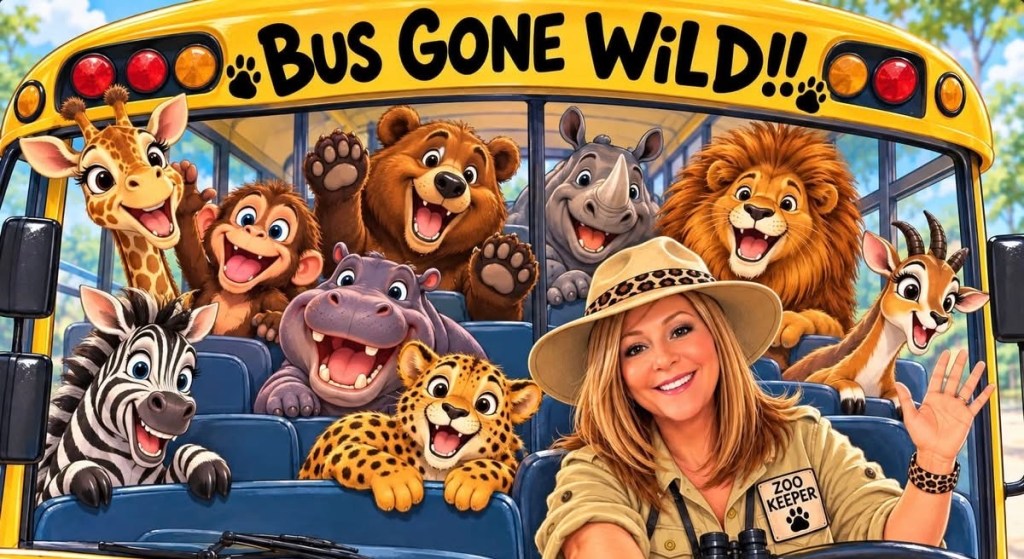
    Sometimes they come from imagination. Sometimes they come from childhood memories, and sometimes they come from climbing onto a school bus every morning and wondering exactly when you became the zookeeper. 😂

    Working in education reminds me just how much personality, energy, laughter, and downright chaos can fit inside one yellow bus. Somewhere along the way, the setting sparked my imagination, and BUS GONE WILD!! was born.

    The animals and their wild ride are straight out of my imagination, although anyone who’s ever ridden a school bus might recognize the chaos. 🚌🦁🐒🐻

    I can’t share too much yet because this little manuscript is currently out looking for a publishing home. But I can introduce you to my imaginary passengers.🤞📚

    Apparently, we have now added a bear—because clearly this bus wasn’t wild enough already. 😂🐻

    Stay tuned. The zookeeper has stories.

    —Glenda ❤️🐻🦓🦁🦛🙊🚌
    #childrensbooks #writing #SELbooksforkids

  • Drowning in Manuscripts and Dust

    I counted my working manuscripts.

    First, I counted 36. Then I remembered two more. Then another whole novel raised its hand from the back of my memory.

    Thirty-nine.

    Lord have mercy. I apparently need a filing cabinet with a lifeguard.

    That’s twenty-eight children’s-book projects and eleven adult-fiction projects, including the eight Brief Encounters. And that doesn’t include my two published books, Grandma’s Wrinkles and The Snow Fairy.

    Some are complete manuscripts that need editing and polishing. Some are rough drafts. One novel has its characters, chapters, and story all laid out, waiting for me to sit down and write it.

    Those characters have been waiting a long time. I’m surprised they haven’t hired somebody to come find me.

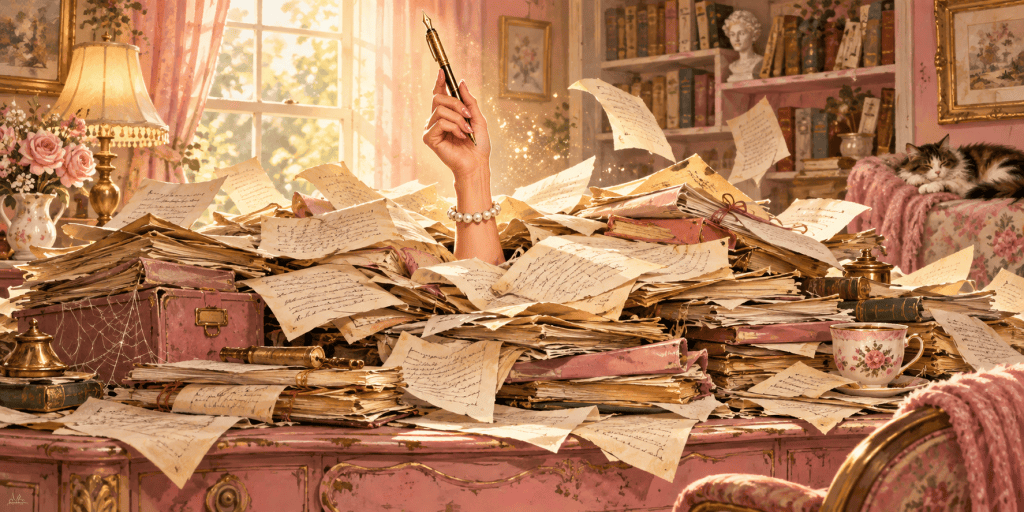
    When I spread my manuscripts out to take a photograph, you couldn’t see my desk. Papers were spilling onto the floor. There were stacks upon stacks of stories, all competing for my attention.

    My first thought was, “Somebody should’ve kicked my butt years ago.”

    My second thought was, “Woman, you’d better get busy.”

    And somewhere between those two thoughts, I picked up another manuscript.

    A Filing Cabinet Full of Years

    When I say I’m dusting off my stories, I mean that quite literally.

    These manuscripts have lived in folders and filing cabinets for years. Some for decades. They came with me through raising children, working, moving, and all the ordinary and extraordinary things that fill a life.

    I would write a story. Work on it. Put it away. Pull it out again.

    Then something else would need my attention, and back into the folder it would go.

    “I’ll get back to that” is a dangerous little sentence. You say it on a Tuesday, and somehow twenty years have passed.

    But the stories stayed.

    The children in them stayed children. The adventures waited patiently. The unfinished novels kept their secrets.

    Now, when I open those folders, I remember where I was when I wrote them. Sometimes I recognize a sentence immediately. Sometimes I think, “Well, I’ll be. I forgot I wrote that.”

    And sometimes I come across something that makes me laugh out loud, which is a little awkward when you’re sitting alone with a stack of paper.

    The Writing Has Been Here All Along

    Many of these pages were written long before AI became part of the conversation.

    I have old drafts, handwritten notes, corrections, and folders full of evidence that these characters have been living in my imagination for a very long time.

    Today, I have tools that help me review and polish my work. But when I spread those old manuscripts across my desk, I can see the years I spent writing them: the crossed-out sentences, the changes of direction, the ideas I couldn’t leave alone.

    That’s part of what I want to share here—the history behind the books, as well as the work happening now.

    Busy Doesn’t Always Look Like a New Book

    At the moment, I have six children’s-book manuscripts out with publishers.

    Others are getting the careful attention they need before I send them anywhere. I’m working through a children’s series one manuscript at a time, checking its educational material as carefully as its storytelling.

    There’s another picture book I’m preparing for a publisher’s consideration after receiving some encouraging feedback from an editor.

    His words were:

    “You clearly know your way around picture book text.”

    You’d better believe I’m holding on to that sentence.

    When you’re sitting alone, reading the same paragraph for the fifteenth time and wondering whether you’ve finally improved it or just moved the commas around, encouragement like that matters.

    So there is progress. There are submissions, revisions, research, and decisions.

    It just doesn’t all come with a cover reveal.

    Learning to Slow Down While I Hurry

    This is the part I’m finding hardest.

    I want to get busy. I want to make up for all those years the manuscripts spent tucked away. Some mornings, I look at the stacks and feel as though I ought to be working on every single one at once.

    But I also want to give each book its best chance.

    That means reading aloud. Listening for the sentence that trips over itself. Checking a fact. Looking again at a scene I thought was finished. Making sure a child’s voice sounds like a child.

    Sometimes it means putting a manuscript aside for a little while so I can come back and see what I missed.

    I’m eager to send these stories out into the world. I’m also making myself take the time to get them ready.

    Those two feelings share a desk over here. Along with thirty-nine manuscripts and, occasionally, room for my elbows.

    One Book at a Time

    My little excursion into Brief Encounters has been fun. I enjoyed stepping into another genre and letting readers see a different side of my writing.

    But children’s books are where I keep returning. I love their humor, their heart, and the way a few carefully chosen words can leave room for a child to discover something.

    That’s where much of my attention is going now.

    I can spend a morning wishing I’d done more years ago, or I can pick up the manuscript in front of me and work on it today.

    So that’s what I’m doing.

    One story. One revision. One submission at a time.

    And when the stacks feel overwhelming, I open a folder, start reading, and remember why I wanted to tell that story in the first place.

    I found the damn pen.

    Now I’m trying to find the top of my desk.

    If you don’t hear from me, check beneath the manuscripts.

    And bring a dust rag.

  • Día de los Muertos: A Highlander Returns

    What if someone you loved could come back—for just one night?

    In Mexico, Día de los Muertos is a time to welcome departed loved ones home. Families prepare favorite foods, light candles, and share memories, honoring the belief that those who have died can return for a brief reunion.

    There’s something beautiful about leaving a light burning for someone you miss.

    But is it crazy to miss someone you’ve only dreamed about?

    I’ve wondered that since the morning I woke up missing him.

    His voice. His touch. The feeling that I had found someone I somehow already knew.

    Día de los Muertos has me thinking about my Highlander.

    Now, I probably should confess: I’d been reading Diana Gabaldon’s Outlander, Dragonfly in Amber, and Voyager. (If you haven’t, you need to crawl out from whatever rock you’re under and read those immediately.)

    Apparently, three books were all my imagination needed to conjure up a Highlander of my own.

    Then he had the nerve to follow me into a dream.

    Naturally, I gave the man a story. Some gentlemen simply won’t stay between somebody else’s book covers.

    And in mine, perhaps the man waiting in the Scottish mist wasn’t simply a stranger from another time. Perhaps he had once held her close. Once whispered her name. Perhaps, somewhere deep inside, she remembered him, too.

    And when the veil between their worlds parted, he found his way back.

    If you had one night with someone you thought you’d lost forever, would you spend it asking how he got there?

    Or would you hold him until morning?

    Here’s a glimpse of Beyond the Veil, from Brief Encounters. Just an excerpt, ladies. You’ll have to wait for the book to spend a little longer with this Highlander.

    Beyond the Veil

    By Glenda Sisk

    He was watching me.

    “Something troubling you?”

    I looked down at our joined hands.

    “No.”

    It was the truth. Whatever questions I ought to have asked seemed unimportant beside the simple fact that he was there. Beyond the windows, mist pressed against the glass. I could not have said how I had come here, only that his hand felt familiar in mine.

    He sat beside me near the hearth. I touched his hair, finding the red in it again, then traced the line of his jaw.

    He closed his eyes beneath my fingers.

    “You’ve been waiting,” I said.

    “Aye.”

    “How long?”

    He caught my hand and kissed my palm.

    I waited, but he gave me no other answer.

    When he kissed my mouth, I leaned toward him as though I had done it a thousand times.

    There was no awkwardness between us. No sense of learning a stranger. He seemed to recognize each hesitation, each small movement toward him. My body remembered a closeness my mind could not quite reach.

    I felt tears gathering.

    He touched one with his thumb.

    “Have I hurt you lass?”

    I shook my head and drew him closer.

    He stayed there until I could speak.

    “I feel like I’ve come home.”

    His eyes closed briefly.

    Then he kissed me again.

    This time, the kiss carried everything we had left unsaid. The longing between us felt almost tangible, stirring something deep within me and making the rest of the world fall away. Even the crackle of the hearth seemed to fade, as though we had slipped beyond the reach of time.

    There was only the warmth of his hand against my neck, the scent of whiskey and moss, and the ache of knowing him without remembering how.

    When the kiss deepened, I clung to him, a quiet sigh escaping before I could stop it. My fingers slipped into his hair, and he drew me closer.

    He kissed me once more, softly, then brushed his lips against my temple. His hand moved slowly over my back, lingering as though there were something he needed to remember.

    He paused, resting his forehead against mine. His eyes searched my face, and I felt a sudden ache for him, though he was still there in my arms.

    “Stay,” I whispered.

    His arms tightened around me as if afraid to let me go.

  • He Promised Coffee. Fate Had Other Plans.

    Who doesn’t love a tragic ghost romance?

    Apparently, I like mine with coffee, a Halloween masquerade, and a man a woman can’t quite forget.

    She only went in for coffee.

    Then they reached for the same cup, their fingers brushed, and an ordinary morning suddenly held a little promise.

    “Maybe tomorrow?”

    Such a small thing to wish for.

    I’ve always been intrigued by those brief encounters that stay with us—the stranger we remember, the connection we can’t explain, the person we hope we’ll see again.

    Add a silver mask and a second chance at that unfinished conversation, and you have Maybe Tomorrow.

    This one is still a working draft, but I wanted to share a little glimpse with you. It belongs with my grown-up encounters, though this time you may need a tissue more than a fan.

    Sometimes “maybe tomorrow” carries more longing than “I love you.”

    Here’s a little glimpse of this haunting Halloween romance, for the grown-ups.

    Would you follow him into this story? Let me know below.

    Maybe Tomorrow

    By Glenda Sisk

    “I’d hoped I might see you tonight “

    She lifted her head. That voice.

    “Your voice sounds so familiar,” she said as she followed him toward the gazebo. “Do I know you?”

    He glanced back with a smile that tugged at her memory.

    “I was hoping you’d remember.”

    She slowed, studying him beneath the silver mask.

    “Brandon?”

    “Yes,” he said softly. “It’s me.”

    “Where have you been? I went back to the coffee shop looking for you.” She paused. “More than once.”

    His smile faded. “I wanted to be there.”

    “But you weren’t.”

    “No.”

    “What happened?”

    “It’s hard to explain.”

    “I thought maybe I’d misunderstood. That you were just being nice.”

    He shook his head and took her hand.

    “You didn’t misunderstand. I wanted to see you again.”

    “Then why didn’t you come?”

    “Things became complicated.” He met her eyes. “But I’m here tonight. And there’s nowhere else I’d rather be.”

    She’d felt it that first morning, too—a connection stronger than their brief time together should have allowed.

    They sat beside each other in the gazebo. He lifted her hand and pressed a gentle kiss to her fingers.

    “I’ve dreamed about this,” he said. “May I kiss you?”

    She smiled. “I was beginning to think you’d never ask.”

    Brandon lifted a hand to her cheek. She leaned toward him, and his lips met hers, gently at first.

    Her fingers curled into the brocade of his jacket, keeping him close.

    When he pulled back, he laughed softly.

    “You are the sexiest ghost I’ve ever seen.”

    She smiled, still holding the front of his jacket.

    “And you’re doing very well as Prince Charming.”

    He leaned in to kiss her again.

    She wrapped her arms around his neck and drew him closer, her fingers brushing the short hair at his nape. This time, she didn’t hold back.

    When his lips lingered against hers, she clung to him, wishing she could make the moment last.

    He gently cupped her breast. A moan escaped her lips, and she arched toward him, her breath catching as she tangled her fingers in his hair.

  • My Fairies Have Grown Up

    My daughter once asked me to write a fairy story. That became The Snow Fairy.

    Then came The Rain Fairy, The Wind Fairy, and eventually even a Tooth Fairy found her way into my children’s writing.

    I’ve always loved a little enchantment.

    But this gentleman with the violet eyes? He belongs on an entirely different bookshelf.

    A tired woman rents a cottage, hears mysterious music, and follows the fireflies into the forest.

    I would tell her to use good sense, but then we wouldn’t have much of a story.

    Today’s little glimpse of the Fae encounter is strictly for the grown-ups.

    The Music That Led Me Astray

    By Glenda Sisk

    He bent his head, his lips brushing her ear.

    “I’ve been waiting for you,” he whispered. “For a lifetime.”

    She lifted her cheek from his chest and looked into his violet eyes. There was no smile now.

    “For me?”

    He nodded, giving her time to search his face.

    Her fingers tightened gently on his shoulder. She had never seen him before tonight. She was certain of it.

    Yet some deeper part of her recognized him with a certainty that frightened her.

    “What does that mean?” she asked.

    “It means I knew you would come.”

    “That’s not possible.”

    “No.”

    “Then why say it?”

    “Because it’s true.”

    She studied him, searching for mockery, manipulation, any sign that he was playing with her. She found only longing—and something that looked dangerously like fear.

    “You’re afraid,” she said.

    His gaze flickered. “Of losing you.”

    “You don’t have me.”

    “Not yet.”

    The words sent a shiver through her, equal parts warning and invitation.

    She reached up and touched his cheek.

    “Well, if I’d known you were waiting for me, I would have come sooner.”

    His laughter was low and warm.

    She smiled, pleased to have surprised him.

    He turned his face into her hand and kissed her palm.

    The tenderness of it unsettled her more than any boldness could have. She had expected hunger. She hadn’t expected reverence.

    She hadn’t asked his name or where he came from. At that moment, she could barely have remembered her own.

    That should have troubled her.

    Instead, she was watching his mouth, wondering whether he would kiss her.

    Her gaze lingered on his sensuous lips. Finally, she glanced up into those violet eyes.

    “Are you going to kiss me or not?”

    His smile widened.

    Then he bent his head and kissed her.

    She leaned into the embrace. His hand slid down to cup her bottom as he pulled her close. A soft moan escaped her lips, almost a sigh.

    “Do you like that?” he teased.

    “If you’re fishing for compliments,” she murmured, drawing him closer, “keep doing that. I’ll write you a lovely review.”

    Glenda Sisk